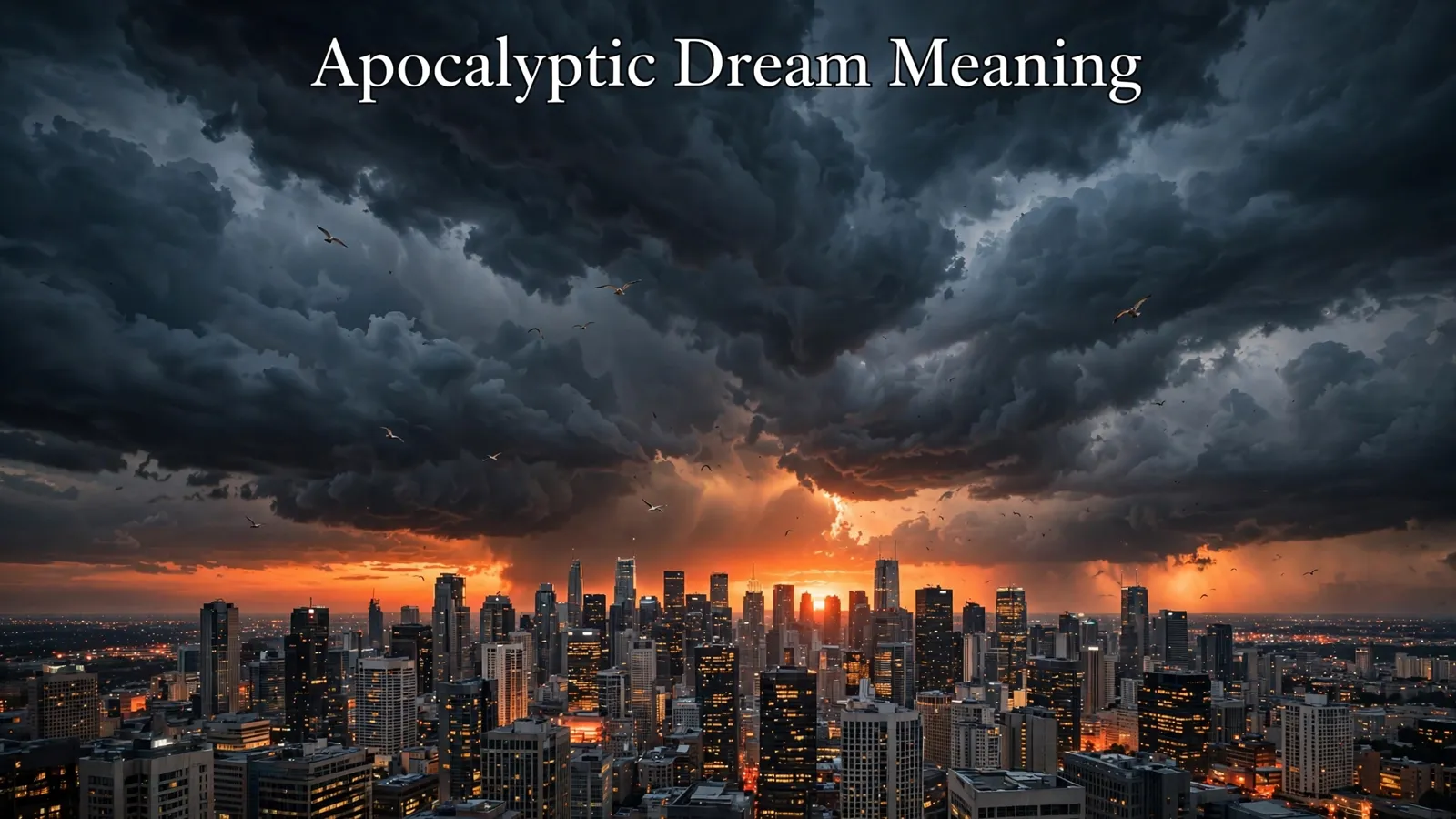
You wake up in the dark, your heart pounding, because in your dream the world was ending. The sky was on fire, or the ground was shaking, or a great flood was rising toward your home. For a moment, the fear feels completely real. Then you open your eyes, and the room is quiet, and you wonder: why would my mind show me the end of the world?
An apocalyptic dream is one of the most frightening dreams a person can have, and it is also one of the most misunderstood. It rarely means the world is about to end. More often, it means that something in your own world is ending, or changing so deeply that it feels like the end. This guide explains the apocalyptic dream meaning in full, from psychology to Scripture, so you can understand what your dream is really telling you.
What Is an Apocalyptic Dream?
An apocalyptic dream is a dream in which the world, or your part of it, comes to an end. The images are usually huge and dramatic: fire falling from the sky, earthquakes splitting the ground, floods covering cities, darkness swallowing the sun, or crowds running from a disaster nobody can stop. You may be watching it happen, running from it, trying to save someone, or simply standing still as everything changes.
The word apocalyptic comes from the Greek word for uncovering or revealing. In its original sense, an apocalypse is not only about destruction. It is about something hidden being revealed. That is a helpful way to read the dream: the end of the world in your sleep may be revealing something about your waking life that you have not been able to see clearly.
These dreams often come during seasons of big change. A divorce, a job loss, a serious illness, a move to a new country, or the death of someone close can all shake the foundations of a life. The dreaming mind turns that private upheaval into a public one: if my world feels like it is ending, the dream shows the whole world ending.
The Psychology Behind Apocalyptic Dreams
Psychologists read apocalyptic dreams as pictures of anxiety, loss of control, and deep change. When the conscious mind cannot process a fear, the dreaming mind gives it the biggest image it can find. The end of the world is the mind’s way of saying: this feels enormous, and I do not know how to hold it.
Fear is usually at the centre. It may be fear of the future, fear of losing someone, fear of failure, or fear that the life you built is not as solid as you thought. The dream does not create the fear. It shows you the fear that is already there, so you can finally look at it.
There is also a loss of control in these dreams. You cannot stop the fire, hold back the flood, or fix the sky. That helplessness mirrors waking life, where some things are genuinely beyond your control. The dream is not punishing you for that helplessness. It is inviting you to notice where you are carrying a burden that was never yours to carry alone.
Some psychologists also link apocalyptic dreams with transformation. Carl Jung wrote about the death and rebirth pattern in dreams: an ending in a dream can symbolise the end of an old identity, and the beginning of a new one. The world that ends in your dream may be an old version of yourself, and the morning after may be the first day of something new.
Apocalyptic Dreams in the Bible
The Bible is full of apocalyptic imagery, and understanding it can take much of the fear out of your dream. The book of Revelation, the visions of Daniel, and the prophecies of Joel all describe the sky darkening, the earth shaking, and the old order passing away. These passages are dramatic, but their message is not only about destruction.
In Revelation, a new heaven and a new earth always follow the end of the old world. The pattern is consistent: judgment, then renewal; ending, then beginning. The apocalyptic visions in Scripture do not aim to leave the reader in despair. They show that God remains in control even when everything familiar is falling apart.
Daniel’s visions follow the same pattern. Kingdoms rise and fall, beasts appear and disappear, and through it all the Ancient of Days remains on the throne. The message is that human power is temporary, and God’s kingdom is the one that lasts.
Joel 2:31 says the sun will turn to darkness and the moon to blood before the great and dreadful day of the Lord comes. It sounds frightening, and the warning is serious, but the chapter ends with a promise: everyone who calls on the name of the Lord will be saved. The darkness is real, and the rescue is real too.
If your dream carries this biblical flavour, it may be worth asking what is ending in your life, and what God may be preparing to build in its place.
The Spiritual Symbolism of an Apocalyptic Dream
Spiritually, an apocalyptic dream can symbolise a season of cleansing. Just as a forest fire clears dead wood so new growth can begin, a dream of ending can point to a life shedding what no longer serves it. A habit, a relationship, a belief, or a version of yourself may be burning away, not to harm you, but to make room.
The dream can also symbolise a call to readiness. In the parable of the ten virgins in Matthew 25, the wise ones kept their lamps full of oil, ready for a moment they could not predict. An apocalyptic dream may be nudging you to prepare: to mend a relationship, to forgive someone, to get your spiritual life in order, or to stop putting off a decision that matters.
Some dreamers feel a sense of judgment in the dream, as if someone is weighing them. That feeling deserves honest prayer rather than panic. Ask yourself: is there something in my life I know needs to change? The dream may be giving you the courage to change it now, while there is still time.
Common Apocalyptic Dream Scenarios and Their Meanings
The way the world ends in your dream changes the meaning. These are the most common scenarios and what they often point to.
The World Ending in Fire
Fire in a dream often stands for passion, anger, purification, or sudden change. A world ending in fire can point to a situation that has become too heated to continue: a conflict, a burnout, or a desire that has grown out of control. It can also point to purification, like gold being refined. The fire may be burning away what is false so that what is true can remain.
The World Ending in a Flood
A flood in a dream usually stands for overwhelming emotion. A world ending in water can point to grief, sadness, or anxiety that feels too big to hold back. It may also point to a cleansing: the flood washes the old world away, and when the waters recede, the ground is clean. If you survived the flood in your dream, that detail matters. It can mean that your feelings will not drown you, even when they feel enormous.
Darkness Covering the World
Darkness in a dream can stand for confusion, depression, or a season in which guidance feels absent. If the sun went out in your dream, it may mirror a time when you cannot see the way forward. The hopeful side of this image is that light often follows darkness in Scripture. The darkest part of the night comes just before the dawn.
Running or Hiding From the End
Running from the end of the world often points to avoidance. You may be running from a truth, a decision, or a loss that you have not yet faced. Hiding can point to a need for shelter, and in a spiritual sense it can also point to God as a refuge. If you hid and survived, the dream may be showing you that safety is still available, even in a frightening season.
Surviving the End of the World
Surviving is the most hopeful version of this dream. It can mean that you will come through a season that feels like the end. The world you knew may be gone, but you are still here, and that means a new world can begin. Many dreamers report feeling strangely peaceful after a survival dream, as if the worst has already happened in the dream, and waking life now feels lighter.
Apocalyptic Dreams and Emotional Blockages
Apocalyptic dreams often point to emotional blockages around safety and love. Two energy centres matter most here.
The root chakra, at the base of the spine, governs safety, home, and survival. When the whole world ends in a dream, the root chakra may be signalling that your basic sense of safety feels shaken. A financial worry, a health scare, or an unstable home can all disturb this centre. Grounding helps: a steady routine, time in nature, and honest conversations with people you trust.
The heart chakra, in the centre of the chest, governs love, grief, and connection. An apocalyptic dream can sometimes be a grief dream in disguise. The world that ends may be the world you shared with someone you lost, or the future you had imagined with someone who is gone. Healing here is slow and gentle. It helps to name the loss, to speak about it, and to let yourself grieve without rushing the process.
Prayer and journaling can support both. Writing down the dream, and then writing down one honest sentence about what feels unsafe or what you are grieving, often brings the first relief.
Cultural Interpretations of Apocalyptic Dreams
Different cultures have read end-of-the-world dreams for centuries, and each tradition adds something useful.
Many Indigenous traditions treat a dream of the world ending as a message from the ancestors or the spirits of the land. It can be a warning that a community has lost its balance, or a call to return to old ways of living with respect for the earth.
Hindu thought treats the cycle of creation and destruction as normal. The god Shiva destroys so that Brahma can create again. You can therefore read a dream of ending as part of a natural cycle, not as a final disaster. Something is ending because something else is ready to begin.
Christian tradition reads apocalyptic dreams through the book of Revelation: as reminders to stay ready, to hold on to faith, and to trust that God will make all things new. The emphasis is on hope, not on fear.
Modern popular culture often links apocalyptic dreams with anxiety about the news: climate change, war, pandemics, and economic uncertainty. If you watch frightening news before bed, your dreaming mind may simply be processing the fear of the day. That does not make the dream meaningless. It makes it a mirror of the world you are living in.
Real-Life Examples of Apocalyptic Dreams
A man in his fifties dreamed that a great fire was consuming his city, and he was carrying his grandchildren through the smoke to safety. In waking life, his company was collapsing, and he was afraid he could no longer provide for his family. The dream helped him see that his real fear was not the fire. It was failing the people he loved. Once he named that, he was able to ask for help, and the dream stopped.
A young woman dreamed that the sky went dark and the stars fell, one by one, into the sea. She was in the middle of leaving a faith community that had been her whole world since childhood. The falling stars were her beliefs, dropping away one by one. The dream did not tell her to go back. It showed her that the ending was real, and that she was allowed to grieve it.
A nurse dreamed of a flood covering her hospital, and she was guiding patients to higher floors. She was exhausted from years of night shifts and was close to burnout. The dream was showing her that she was carrying too much, and that the flood was her own tiredness rising. She cut her hours the following month, and the dream never returned.
What to Do After an Apocalyptic Dream
A frightening dream does not have to control your day. A few simple steps can help you use it well.
First, write it down. Note how the world ended, what you did, who was with you, and how you felt when you woke up. The feeling is often more important than the images.
Second, ask what is ending in your waking life. Is it a job, a relationship, a belief, a season, or a version of yourself? Naming the ending takes away much of its power.
Third, pray or sit quietly with the dream. You do not need a perfect interpretation. Sometimes the most useful question is simply: what is this dream asking me to pay attention to?
Fourth, take one practical step. If the dream points to burnout, rest. Reach out if it points to a broken relationship. If it points to fear about the future, make one small plan. Action turns a frightening dream into a useful one.
Finally, remember that an apocalyptic dream is not a prediction. It is a picture of change, and change, even when it feels like the end, is often the beginning of something new.
FAQs About Apocalyptic Dream Meaning
Does an apocalyptic dream mean the world is going to end?
No. An apocalyptic dream almost never predicts a real world-ending event. It usually reflects a big change, a deep fear, or a feeling that your own world is ending. The dream uses the largest image available to show you an emotion that feels enormous.
Why do I keep dreaming about the end of the world?
Repeated apocalyptic dreams usually point to ongoing stress, unresolved grief, or a major life change that has not been fully faced. They can also come from heavy news consumption before bed. When the waking cause is addressed, the dreams usually become less frequent.
What does it mean to dream of fire ending the world?
Fire in a dream can stand for anger, passion, purification, or sudden change. A world ending in fire can point to a situation that has become too intense, or to a process of cleansing in which old patterns are burning away so something healthier can grow.
Is an apocalyptic dream a warning from God?
It can be a call to readiness, prayer, or change, and many people of faith read it that way. The Bible uses apocalyptic images to call people back to God and to promise renewal after judgment. The right response is not panic, but honest prayer and one practical step.
What does it mean to survive the end of the world in a dream?
Surviving is a hopeful sign. It can mean that you will come through a difficult season, even if the world you knew changes completely. The dream may be showing you that you are stronger than you think, and that a new beginning is possible after the ending.
Conclusion
An apocalyptic dream can leave you shaken, but it does not have to leave you hopeless. The end of the world in your sleep is rarely about the world at all. It is about a season, a belief, or a version of yourself that is coming to an end, and about the new life that is waiting on the other side of that ending. In Scripture, a beginning follows every ending, and light follows every darkness.
Hold on to that hope. Name what is ending, take one small step, and trust that the morning after the dream is the start of something new.

I am Luna Hart, a dream interpretation expert and spiritual writer at DreamSignalz.com, helping readers uncover the hidden meanings behind their dreams. I blend psychology and intuition to guide people toward clarity, self-discovery, and personal growth.